New! SU Podium V2 is available. Upgrade or purchase here.

Trouble Shooting/ FAQ Table of Contents for V2

Languages

日本語

A. Trouble Shooting

SU Podium V2 will not run on SketchUp 6 or any SketchUp version prior to SketchUp 7. Mac version will require OS-X 10.5.x or above. The V2 engine is multi-threaded meaning it will take advantage of all your CPU core's. You also need a reasonable amount of RAM to hold 3d scene data. The more RAM you have, the more complex models you can render. For Windows there is both a 32 bit version and 64 bit version of SU Podium V2. For the Mac, SU Podium V2 is a 64 bit application.

Note Windows users: 64 bit version will not run on any version of Windows that is 32 bit. So be careful of what version you install. 64 bit version will take advantage of any memory above the 4gb.

Installation requires administrator status

    You need to have a user account that has is an Administrator (Windows) or your account to administer your computer (Mac) to successfully install and license SU Podium V2.

After installing, SU Podium V2 is not in my SketchUp plugins menu

    There are two possible reasons for this

    Mac

    Make sure you download either the SketchUp 7 or the SketchUp 8 version of Mac SU Podium V2 and install the appropriate version. If you downloaded the wrong version, click here to download the correct version.

    Windows

    The default install location for SU Podium V2 is \program files (x86)\google\google sketchUp 7\plugins\. Change this location to ..\google sketchUp 8\plugins\ if you are installing for SketchUp 8. It's best to simply change the 7 to 8 instead of using the Browse button in the installation. If you use the Browse button, pick \google sketchUp 8\ folder and not \google sketchUp 8\plugins\ folder because there is a possibility that the install will create a plugins folder within the plugins folder.

I downloaded the wrong version. What should I do?

    Click Here to download the correct version. You will need your V2 license code.

Install Failure issue - Mac

Back to TOC

    Install Failure message are rare but do happen on some Mac computers for unknown reasons. There are two solutions to overcome this problem.

    Make sure you have the most current version of SU Podium V2 for the Mac If you are not sure that you have the most current update of SU Podium V2, click here and download and updated version.

    It is not necessary to remove the previous version of V2 before installing the downloaded update but it is a good idea. You will need to re-activate your license if you remove V2 so make sure you have your license before removing V2. To remove a previous version of SU Podium V2, go to Macintosh HD\Library\Application Support\Google SketchUp 7 (or 8)\SketchUp\Plugins\ and remove the SU_Podium_V2 folder and SU_Podium_V2.rbs files. Next install the updated version. Still having Installation Failure messages? Please look at the second option.

    Use Pacifist If the above update still fails to install, use a shareware program called Pacifist from CharlesSoft - http://www.charlessoft.com. This program will bypass the Podium Mac installer and install Podium to the correct folders.

      First locate the folder where the install file for SU Podium V2. If you have not unzipped the SUPodium_V2_SU8_xx.zip or SUPodium_V2_SU7_xx.zip, unzip it. This will extract the SUPodium_V2_xx package file.

      Download Pacifist from http://www.charlessoft.com and install it (drag the Pacifist file to the application folder.) Then run it. It will ask for a package file. Select the SUPodium_V2_xx package file. Next tell Pacifist to install or extract the Podium files. There are 2 files and one folder. ( SU_Podium_V2 folder and SU_Podium_V2.rbs and plsv2.rbs)

      Install is the easiest method. It will install Podium files and folder to the correct, default directory which is Macintosh HD\Library\Application Support\Google SketchUp 7 (or 8)\SketchUp\Plugins\ folder.

      Once that is done. Open SketchUp and see if SU Podium V2 is installed. Render something and you will be prompted for a serial number before OOPR starts. Once you enter your serial number and get a License accepted message, click Render again.

      You can also extract files using Pacifist if the install option does not work

OOPR will not run - Win/Mac

    OOPR is Podium's Render Manager. It is invoked automatically after you click the Render icon and the geometry process is completed. A script file is then saved to a temporary folder and the Podium Render Manager reads the script file and runs it. OOPR does the raytracing/ global illumination/ anti-aliasing, process. Make sure you have the most current version of SU Podium V2. Go to item #8 to see how to download the most current version.

    If installing the most current version does not solve the problem of OOPR not running see below:

Anti-virus or firewall program conflict with OOPR or the license manager- Win/Mac

    Some firewall or anti-virus programs have been reported to conflicts with SU Podium V2's license manager and/or the Podium Render Manager (OOPR.exe). The symptom will be where the License Manager or OOPR will not running at all. You may see an error message about OOPR not running. Because of this conflict, you will not get an opportunity to license Podium and will not be able to proceed with the render. If there's a question of that, turn off your firewall or anti-virus program temporarily to see if Podium will complete it's rendering process.

OOPR crashing - Win/Mac

    If SU Podium V2 has been successfully installed and licensed and you are finding OOPR frequently crashes, there could be several reasons for that. Most common reason would be that there is not enough computer memory to render you particular model. Please try rendering one of the fairly simple models from this page first to determine if memory may be the problem. Click Here to go to the Sample model page. Contact Support if this problem persists.

Where to download the most current version

    If you are using the full version of SU Podium V2 and want to download the most current update click here. Please note that this page is only for SU Podium V2 license owners. It's a good idea to uninstall the previous version of SU Podium V2 before installing the update. Mac users - Please take a look at the Install section of the Help page to see how to do that.

I have the full version but I can not change image resolution size

    If you have a full license of SU Podium V2, make sure you re-start SketchUp after activating your license to get out of trial mode.

Blank dialogs in SU Podium V2

    A few Windows customers are experiencing a situation where the SU Podium web dialog boxes of materials, lights and options, appear blank or white.

    SketchUp Pro uses web dialog boxes for some of its user interface. The Component Options dialog is an example. Web dialogs are fantastic for developers because they can run on both Windows and on the Mac. On Windows, the web dialog box settings are controlled by the Internet Explorer settings. SU Podium uses SketchUp web dialog boxes for the Options, Materials and Lights usesr interface. What happens to some Windows users is, the Java Scripts that are to be executed when the web dialogs are invoked, are blocked. If you experience this problem, you will probably find the same issue in SketchUp's Component Options dialog box as well and in other non-Sketch Up programs.

    This is not a SU Podium specific problem but is related to Internet Explorer security settings. Sometimes the security settings are set in the Windows registry.

    We are unable to duplicate the problem on any Windows (XP, Vista, Win 7) computer in Cadalog, Inc.'s office so we think it is a relatively rare occurrence. However, there is a discussion about this on the SU Plugins Forum here - blank web dialog problem

    You can also read about similar problems occuring in SketchUp here - blank web dialog in SketchUp

    The work around is this - create a new Windows User Account. Make sure it is an administrator account. Log out and log back in using this new User Account. Restart SketchUp. This seems to reset the registries. This work around has worked in very case we have encountered.

B. Known issues and common questions

Back to TOC

Imported images do not render or render black

    If you import images as is in SketchUp (File, Import), the images will not render or render black. You should either import the images as textures or explode the images after it is imported.

Instanced Components with the same texture bug and render black or distorted

    If you assign texture to a component and then copy or mirror that component, Podium V2 will render the component's textures black or in a distorted fashion. The solution to this bug is to explode one of the instanced components. You just need to explode one of the copied or mirrored components. You can turn the exploded geometry back into a component after exploding it.


    Distored textures in a group that was mirrored

    Work around is to explode one of the groups

Textures on reverse or back side faces

    There is an issue with textures that are assigned to the back side of a face and then are exposed in the model. Podium V2 will render these textures inversely. To avoid this problem, make sure exposed faces are front side and not back side.

    How can you tell which face is front side and which is back side? There are a couple of ways to find out.

    SketchUp 7 and 8 has a nice tool that will turn off textures and display only the monochrome color of all the faces in the model. In SketchUp the normal or front side of a face is a light tan color and the back side is a darker, usually blue color. Using the monochrome icon in the Face Style tool bar, you can see which face is blue or back side. When you find the blue or back side faces, right click on them and use the Reverse Face option. You will have to reapply the texture to the front side face.

    The other method is to right click on the face and pick Entity Info. You will see two image panes in the Entity Info box. The left side is the front side. The right is the back side. Which side is the texture on?

How can I save the rendered image into the folder I want?

    If you are seeing a line in the Podium Render Manager (OOPR) that reads, Total Time 00:xx:xx, it means the image was finished and saved. As a default, the image is being saved in the same folder as the where the SketchUp model is.

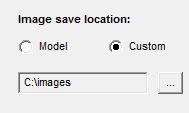
    If you want to change the folder where the image will be saved, use the Custom button in the Podium Options dialog box. Click on the Browse button to change folders.

    If you are still unable to save the rendered image to a folder, try creating a folder on your primary drive (for Windows, C:\, for Mac under your user name). Make it an obvious name such as c:\images.

    There are problems saving images in folders with names that are more than 32 characters or have double byte characters in them. This is a Windows only problem. SU Podium will ignore the folder name and save the image to the default SketchUp model folder location or to a temporary folder. Make sure your designated folder name has less that 32 characters and that there are no double byte characters (Japanese, Chinese, Korean, Middle Eastern languages) in the folder or file name.

Changing light value in an omni grid, light fixtures and point lights

    To change the light power of any point/omni light, click on the light group in the model or use SketchUp's Outliner and select the light group. The light group will have a name such as <light-point-2#x>. Once the light group is selected, pick the Light Properties or the Podiun Light System icon from the SU Podium V2 tool bar. Change light values using the Light Properties. Keep in mind you can use decimals values for omnis such as .25.

    For the Omni Grid, find any one of the light groups using SketchUp's Outliner and change the light power and all the other light groups in the grid will update. Omni Grid consists of a main Group--->Individual Component-->Light Group. The components are instances of each other. Outliner is the best way to pick the light group in the Omni Grid. The light groups are nested within the main group, down 2 levels.

When I select a material, it does not show in the Podium Material dialog

    If you select a texture that is on a curved surface, the texture's name will not appear in Podium V2's Material dialog box. Select that specific material from SketchUp's Material browser (Windows) or use the SketchUp material selection (eyedropper) tool. This is true for textures that are on a back side (reverse side) of a SketchUp face as well. If you select the material in question by using the eyedropper or by selecting it from SketchUp's material browser (Windows only), the materials now will be displayed in the Podium Material dialog.

Quick way to control sun/sky brightness

    Unlike SU Podium 1.7.3, the dark slider in SketchUp Shadows setting has no effect on SU Podium V2 rendering. But there are several ways to control the overall sun and sky brightness. Here’s a quick introduction.

    One thing to keep in mind is SU Podium V2’s Physical Sky (in the Options/ Environment tab). As a default, Physical Sky is off but if it is on, it will simulate sky turbidity and depth. Podium will only render Physical Sky when it is turned on AND when SketchUp Shadows are on. When Physical Sky is on, the sun intensity and exposure sliders in the Environment dialog are the most effective way to change sun light. Changing the sun’s angle by changing SketchUp’s time of day is also effective.

    Your choice of SU Podium Presets will also effect sun/ sky brightness greatly. The default preset or default.pps is created with no specific environment in mind. It is the fastest preset. However, if you are rendering an outdoor or exterior scene, use one of the exterior presets. You will be able to control the sun and sky brightness more effectively. The interior preset is a very bright preset and is intended for interior scenes. For more presets then the standard presets, please go to the Preset web page.

    Physical Sky has a sky color gradient that you can not control. The color will depend on the time of the day that your SketchUp shadows are set to. If you don’t like this effect and/ or want to have control of the sky color as well as additional control of sun light, do the following:

  • Turn off Physical Sky in the SU Podium Options/Environment dialog.
  • Go to SketchUp Styles and then to Background. Turn off Sky. Darken the color of your background.
  • If your SketchUp Shadows are on, change the time of day of month so the sun is at a different angle.

Black Rendered textures - several reasons

    There are several reasons for black rendered textures.

    • One common reason for unexpected black textures in rendering is this – LEM light that are on materials that are on back side of a SketchUp faces. If LEM (Light Emitting Material) is applied to a material which is on the back side of a SketchUp face, the material will either render black or not at all. Click here to read about checking back side and front side faces in SketchUp.
    • Textures on reverse or back side faces. Please see here - Textures on back side of faces.
    • Another possible reason for black textures is because of the instanced group/ component texture bug described above. Please read here.
    • 3D Warehouse models. Some complex models from 3D Warehouse have been created in non-SketchUp 3D programs with textures that Podium has difficulty rendering. Simple solution to this is to explode the imported component so that the textures get mapped to specific SketchUp faces.
    • Textures with bad extensions, vector based or double byte names. If you run the SU Podium V2, Tools, Analyze Model program, it will reveal if any of the textures in your SketchUp model have potential problems. These textures may render black. One problem is imported textures that have no extension name. Another potential problem is textures that have not been converted to bitmap textures. These would be .pdf or .psd textures. Another potential problem is textures with very long names or double byte names.

Two point perspective is not supported

Other known issues

a. Support for large or complex models. Even with the Podium Rendering Manager models that are larger than 800,000 faces may crash. Limitations on memory use means that some models will not render because the system will run out of RAM. Use the Windows 64 bit version of Podium V2 if you have more than 4 GB of RAM. However, note, that there have been some reported difficulties rendering slow downs with Win64 bit version. The Mac version already supports 64 bit.

b. The rendered results are dependent upon the preset chosen. Some presets are configured for different types of scene and will produce strange results on others. You may need to experiment to find the best preset.

c. Podium V1.x lights will not work in V2 due to differences in the way the 2 render engines work. The V2 light fixture library is included in SU Podium Browser which is installed with SU Podium V2.

d. Blurred reflection and refraction, will slow down the rendering process.

C. Tips and Tutorials

Something about Presets - preset page

Styles for SU Podium V2

Hidden LEM tip- render a computer monitor or TV

How can you create the effect of a computer monitor or TV screen illuminating an interior space. You can create this effect with the new hidden LEM.

    This image was produced by Steven313 (Forum alias). Read about his discussion on how to do this on this thread - Hidden LEM tip

How to get rid of blotches

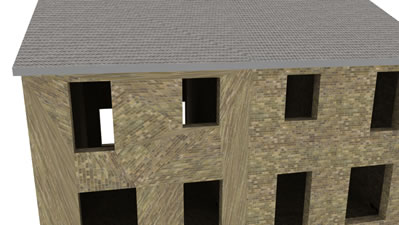
    SU Podium V2 presets are calibrated to be as fast as possible. Unfortunately, some imperfections such as blotches or unexpected corner shadowing will sometimes appear in the rendered image. These anomalies can appear quite randomly especially on non-texture pale surface, corners and low polygon geometry scenes. Those imperfections are caused by the lower quality and precision of the Podium V2 preset.

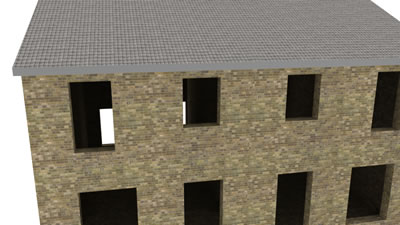
    QMC presets are made especially to overcome this issue. But the cost is a substantially slower rendering time. QMC presets can also produce a more grainy image. To overcome the graininess of QMC presets, it is recommended that you render at a higher pixel resolution than you need and re size the image after it is completed.

    This will solve most of the current blotches and artifices. If they are still appearing with the QMC presets, please contact us.


Before with interior preset

After with QMC-interior preset

Interior Lighting

Getting ready to print

    SU Podium's image "resolution" settings are based on pixel dimensions such as 800 X 600 or 1920 X 1080. Podium allows for pixel dimensions that are greater than most video monitor sizes such as 4,076 X 3,304 pixels. You can even enter a custom size such as 8,000 X 6,000. Why do we offer higher pixel dimensions than what most monitors provide? Primarily for printing. The higher the pixel size image you have, the greater the paper size and document resolution you can print to. When it comes time to print your image, there are some calculations to be made.

    For example, if you want to print a rendered image of the size of 36" by 24" at 200 DPI (Inkjet), the pixel resolution in Podium should be around 7200 X 4800.

    SU Podium does NOT have any print capabilities. The JPG or PNG file generated by Podium will need to be printed from an image editing program such as Photoshop, Fireworks, Paint Shop Pro, etc. The one feature you will need from your image editor is the ability to change the print size dimensions and the Dots per Inch.

    There are two terms often used in printing and that is PPI and DPI. They are often used interchangeably although technically they have different meanings. The default resolution in Pixels Per Inch (PPI) for JPG/ PNG generated for a computer screen is 72. Images on a monitor will look good at 72 PPI but if you print on most paper sizes at 72 PPI, the print will not look good.

    Open a Podium generated PNG in Photoshop or Fireworks and look at the image size. If you opened a 1200 X 700 image in Photoshop, you would see the document resolution is 72 Pixels/Inch and the default print size is 16.667 X 9.694 inches. If you were to print at these dimensions, the resolution of the document would be poor. To get better print results, you need to increase the document resolution by increasing the PPI or DPI.

    Turn Resample Image option off and increasing the PPI to 360. Now the document size is approximately 4 X 2 inches. That means if you want to print an image that has a pixel size of 1200 X 700 on paper, the paper size would have to be about 4 X 2 inches if you print at 360 PPI.

    Open an image in Photoshop (or your favorite image editor) that is 3076 X 2304 pixels. Turn Resample Image option off and increase the Pixels/ Inch to 300. You can print this at 10.253 X 7.68 inches and at 300 PPI. As you can see, the higher the pixel size of the Podium image, the more document size and print resolution options you have.

    Printers use DPI measurements such as 300 DPI of Laser Jets or 200 DPI for Ink Jets. Although we often equate PPI to DPI, DPI is a print term and is the number of dots of ink a printer can place per inch. Most often the printer's DPI is set to some number like 200 or 300. The main thing to consider is the higher the document resolution measured in Pixels/Inch, the better your print will look.

    There is a related article here - http://photo.net/learn/resize/. Also, if you are confused about inch sizes and want to translate to MM take a look at this paper size calculator web page - http://www.dpandi.com/paper/index.html. Another useful image size/ paper size calculator web page is here - http://auctionrepair.com/pixels.html.

Podium Materials - Why Diffuse, Transparency & Reflection?

    When you start to set up your own materials, you will start in SketchUp by applying texture, color and transparency. SketchUp allows you to configure and display these basic material properties.

    Podium supports some more complex and subtle properties like reflection, refraction, bumpiness and light emission. These are very straightforward to set up. But there are some things that it are helpful to understand first of all.

    There are three main sliders in the dialog labelled - Diffuse, Transparency and Reflection. These configure the basic surface properties, and this article explains them in a little more detail.

    In reality, the way you perceive a material is based on the way rays of light (the technical term is ‘photons’) hit the surface, reflect off it and travel to your eye. Light is actually invisible until it hits something. If you shine a flash light in a cave, the only light you will see is reflected off surfaces. You will see a patch of light where the it hits a surface, but if there is no dust or water vapor, you will not see a beam of light like a laser. Where you can see a distinct ‘beam’ of light, this is caused by light reflecting off particles in the air. This illustrates the basic principle that our ability to see objects is entirely based on the principle of reflected light.

    When light hits a surface, some of the energy is absorbed, and some reflected. Diffuse reflection is what enables us to perceive color and texture, and describes the way that when light hits an object, it penetrates just below the surface of a material and is reflected, but the light is ‘diffused’ or scattered in different directions. Even highly polished surfaces have diffuse reflection. For example, a polished white marble surface is still identifiably white. When light hits a surface, the color the surface appears depends on the wavelengths of light absorbed and reflected by the surface. For example if a surface absorbs more light in the red spectrum, then that surface will not exhibit much red in the color If the surface reflects more light in the red wavelength, its color will appear to be reddish. This is a complex topic in its own right (more info here) but it demonstrates that you almost always need some diffuse reflection for any surface. Even for colored glass, if you want to see the color, you need an element of diffuse reflection.

    What people usually understand by the term ‘reflection’ is technically ‘specular reflection’ and it occurs when light bounces off flat surfaces and is reflected in a uniform direction. This is easy to understand, and as you increase the value of this slider, the more your material will reflect the environment.

    The third component is transparency, which is when light passes through a surface.

    A material’s appearance is based on the way light interacts with the surface. Some of the light is absorbed some passes through it, some is reflected back and diffused, and some is reflected back in a uniform direction.

    Podium’s way of rendering materials is based on these physical properties. So if you want to get the most realistic materials, you need to be aware of the need for the diffuse component, and balance this against reflectivity and transparency.

    In Podium, because almost all materials absorb some of the light that hits them, materials are configured so that if the sum of the diffuse, transparency and reflectivity sliders adds up to 100% in the dialog, the actual total used by the render engine is around 95%. It is also impossible to configure the sliders so they add up to more than 100% which would be unrealistic because it would mean that materials reflect more light than they receive!

    For most materials, the most realistic appearance is obtained when the sum of the values in all three sliders adds up to around 100%. It does not’t matter if it’s 97% or 98%, and some solid, non-reflective surfaces (like wood for example) may absorb more than 5% of the light energy that hits them, so configuring them by setting the diffuse slider to 80% should’t be a problem.

    In summary, when configuring materials, understand the diffuse component, and set some value for it for virtually all surfaces.

    Preparing for Exterior Renderings

    The first step to setup any Podium rendering is to choose which preset to use. There are three categories of presets; default, exterior and interior. Default is a general purpose preset not calibrated for anything specific. On the other hand the two others presets are especially made to give the best results for their specific environment. In addition, these two presets have several variation to give different quality and speed results which are preview (lowest quality but fastest), QMC (highest quality) and the standard.

    Although, it is recommended to use the QMC preset, when you notice imperfections, blotches or blemishes, 1.0_exterior.pps is often sufficient. Default.pps preset is not adequately calibrated for exteriors scenes and results in unbalanced rendering such as too bright or too dark. 1.0_exterior.pps is generally the best choice for your exterior scenes. (Exterior scene would be defined as a environment that uses either sun light or sky light or both as predominant light source.)

    After you have selected your preset, you can adjust sky and sun light. Do not forget to activate shadows in SketchUp for Podium to use Physical Sky and use its own sun orientation. Podium physical sky is the key for realistic renders. This will give a greater color depth than the SketchUp sky. Make sure it is activated in the “Environment” tab of the Podium Option window. It is also in this window that you will able to adjust the Sun strength. You can modify brightness with the intensity and exposure sliders.

    Intensity controls the brightness of areas that are exposed to sunlight. Exposure will control brightness of shaded areas. If you want to simply adjust the sun’s strength, move the two sliders equally. Be generous because less than 25% changes will not have an effect.

    Sun Intensity/Exposure at 0%

    Sun Intensity/Exposure at 100%

    You are now ready to do some test renderings, add advanced material properties and some detailing to get the best rendered image.

Using PP to finalise your rendering

    If you did not already know, the acronym “PP” which is vastly used in the rendering world refers to Post Processing. It is a “second touch” to your images produced by the renderer. Many programs will help you do this. The most popular, Photoshop, will be used in this article, but many other lower cost or free image editor exist. Some examples would be Paint Shop Pro, Fireworks, Gimp and even Adobe Elements.

    The goal of PP, is to fine tune your images; tweaking it to your liking, with speed and a lot of control. Using PP is a lot faster then re-rendering in Podium each time you need a tweak and therefore is very productive. Many PP features are not offered in Podium simply because they are readily available in PP programs. Post processing programs are especially good at tweaking colors, brightness, contrast, etc. so lets leave these features to them. In addition, all photography and rendering professionals uses PP. Post processing is often a necessary part of your work flow as you can not expect even the most advanced photo-realistic rendering program to output perfect images every-time.

    Good lightning is crucial for a high quality image and can be tricky to achieve directly in Podium. That’s where PP comes to help. There's no need to fine tune your lightning in Podium/ SketchUp. One acheivable goal is to get all the correct light sources to provide an acceptable level of brightness in Podium. Then, adjust the lighting to your taste in PP. For example, a dark rendering is easy to brighten-up whereas an image that is too bright will often be beyond repair. So it is better to aim for less brightness in Podium to be tweaked in PP, where you have instant response and lots of control.

    In Post Processing programs, the brightness feature generally will not give you good results as it will whiten or darken the entire image. What we want to do instead is to brighten the white areas, almost as if the Podium lightning was stronger. That’s where the “Levels” tool in Photoshop ( CRTL+L) is very helpful. Move the right slider to the left to brighten your image, but do not overdo it, so as not to lose information. Moving the left slider a bit to the right will also add some depth.

    When the graphic shows low values on the sides, the sliders can generally be moved towards the middle without losing too much information. This is often when they need to be moved.

    eree

    Below - Before: Raw Podium render - almost too dark to be usable.

    ereree

    Below - After Post-Processing: Levels adjusted to brighten up. Color balance to match the out-door photo and photo integration.

    er

    Below - Example of an over-lit rendering that cannot be saved

    er

    Many other modifications can be made, to make your renderings look better, such as; color balance (reducing the blue tint) saturation, depth of field, god rays etc. All of these, and many more have extensive tutorials on the Internet.

    You many wonder why SU Walk, includes a brightness slider and Podium does not. The reason, beside all the othersmentioned above, is pretty simple. Walk is a real-time application used for video animations. When you change the value, you see the result immediately. That would not be the case for Podium. It would cost a lot of develop time to have PP features in Podium that are readily available in lots of image editing software.

    PP techniques will save you a lot of time and help make your renderings look great with some practice. Head over to the Podium forum to get insight from us and other members on how to make your rendered images look better or show the rest of us your skills and techniques.

    Happy rendering,